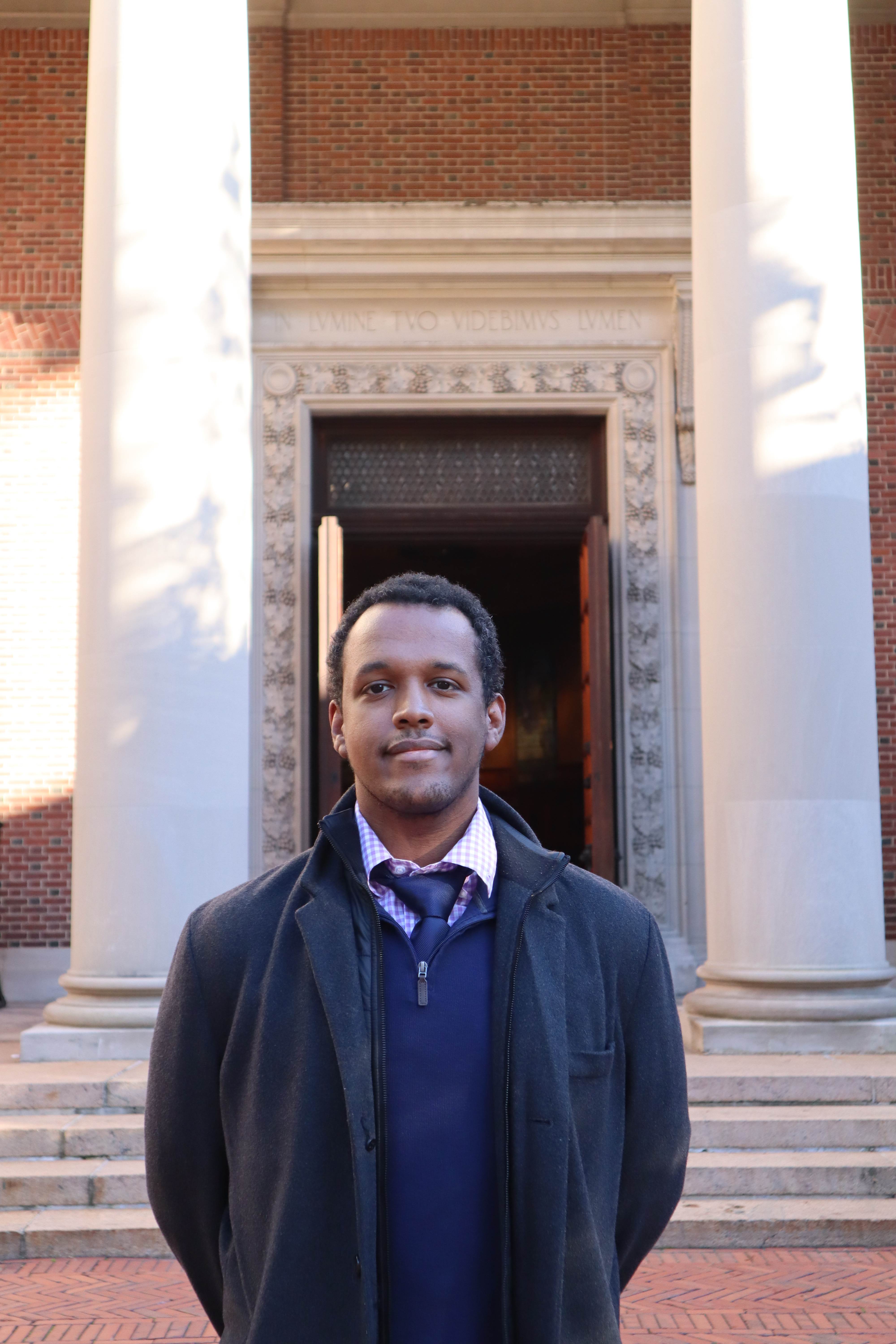
Mixed-Methods Insights Researcher

Daniel Yonas, PhD

Behavioral scientist who turns rigorous research into decisions teams can act on.

I design, field, and analyze large-scale, mixed-methods studies, pairing quantitative rigor with qualitative depth to inform product, strategy, and policy. Across projects totaling 10,000+ participants, I've owned every stage of the research lifecycle and turned large, messy datasets into one-page readouts that teams use to prioritize features, sharpen messaging, and decide what to build next.

Daniel Yonas

What I bring to a team

A research partner who connects individual studies to the bigger bet, and makes it easy for teams to act quickly and tie decisions to outcomes.

End-to-end research ownership

From scoping business questions with stakeholders to instrument design, sampling, analysis, and decision-ready readouts, I run the full lifecycle without dropping rigor.

Quant + qual integration

Advanced modeling in R and SPSS alongside systematic qualitative coding, triangulated so the 'why' always aligns with the 'what.'

Insight that drives decisions

One-page executive summaries, clear visual stories, and prioritized recommendations that help product, design, and leadership move with confidence.

Research ops & scale

Reusable templates, compliant recruitment workflows, and searchable insight repositories that keep prior learning findable and let teams move fast, ethically.

Experience

Research Scientist

Sept 2025 – Present

Purpose Science & Innovation Exchange (PSiX), Bronfenbrenner Center for Translational Research, Cornell University

  • Co-led design and launch of a national survey of 2,000+ adolescents and young adults (ages 15–25) examining purpose across the transition to adulthood
  • Designed and executed 4+ mixed-methods studies on lifespan perceptions of purpose, drawing on 500+ participants across 6+ developmental age groups
  • Ran trajectory and moderation analyses in R across 5+ analytic pipelines, producing 12+ publication-ready figures and stakeholder reports
  • Directed qualitative coding for a study on immigrant youth development: a 20-code codebook across 6 domains with strong inter-rater reliability across a team of 4

Lead Researcher

Aug 2020 – Jul 2025

Columbia University, Department of Psychology

  • Designed and executed 17 mixed-methods evaluation studies (surveys, observations, interviews) engaging 10,000+ participants
  • Applied multilevel and predictive modeling in R and SPSS, integrating quantitative results with qualitative thematic coding to assess outcomes
  • Facilitated workshops on survey design, usability testing, and rapid experiment iteration, equipping 60+ instructors to collect and act on feedback
  • Mentored 10–12 junior researchers in data collection, ethics compliance, and inclusive research protocols

Research Specialist

Jul 2019 – Jun 2020

EL Education Study

  • Led mixed-methods evaluations across eight multi-site projects, coordinating remote data collection and ensuring data integrity in K–12 settings
  • Created and iterated 10+ surveys and interview guides, applying insights to refine digital learning tools and supporting materials
  • Acted as primary liaison among cross-functional stakeholders, translating findings into recommendations that informed curriculum roadmaps and policy

Project Manager

Jun 2018 – Jul 2019

Marsh Montessori Study

  • Managed a mixed-methods study of long-term educational outcomes, integrating administrative records with surveys and interviews
  • Developed measurement instruments (Qualtrics surveys, interview guides, observation rubrics) to assess engagement, learning, and motivation
  • Coordinated recruitment and scheduling across families, teachers, and alumni, ensuring inclusive sampling across subgroups

Selected work

Two peer-reviewed studies, framed for what they mean in practice: how I move from a fuzzy question to evidence a team can act on.

Behavioral research · Audience insight

What people want to know when something goes wrong

When users encounter a negative experience, what drives their need to understand “why,” and how does that differ across audiences?

Curiosity about wrongdoing vs. good deeds, by age
0.12Ages 4–60.52Ages 7–90.63Adults

Preference shown as Cohen's d. Data: Yonas & Heiphetz Solomon, Child Development (2024).

669
participants
3
controlled experiments
3
age segments

The challenge

Teams often assume curiosity and attention are uniform across users. I tested how people decide which events are worth understanding, positive ones versus things that go wrong, and how that tendency shifts from early childhood to adulthood.

My approach

Designed and ran three forced-choice behavioral experiments across preschoolers, school-age children, and adults. Isolated the underlying driver with a mediation analysis (5,000 bootstrap samples) to rule out competing explanations.

What the data showed

People disproportionately seek out the “why” behind negative events over positive ones, and that bias grows with age (effect sizes ~0.5 to 0.6 in older groups vs. 0.1 in the youngest). The driver was specifically how much weight someone places on intent, not how surprising the event was.

Why it matters for teams

A concrete model for segmenting how audiences process information: younger audiences attend broadly, while mature audiences zero in on what went wrong and why. Directly useful for content strategy, trust & safety messaging, and onboarding flows that need to surface intent when something breaks.

Program evaluation · Equity & inclusion

Does this learning model actually serve the students it’s for?

A widely funded education model raises test scores, but does it work for the population it targets, on the outcomes that actually matter long term?

What alumni described, mapped to culturally responsive practice
  • Sense of agency“allowed me to practice” being capable
  • Belief in capabilityhigh expectations, internalized early
  • Belonging & respectseen and valued in the classroom

Themes from interviews with 12 alumni. Source: Lillard, Taggart, Yonas & Batson-Seale, J. of Negro Education (2023).

12
in-depth interviews
Mixed
methods design
20+ yr
outcome horizon

The challenge

Quantitative scores alone can hide whether a program genuinely serves an underserved group. I evaluated an alternative education model for Black students by centering lived experience alongside measured outcomes.

My approach

Ran a mixed-methods evaluation: in-depth interviews and a survey with adult alumni of a predominantly Black school, systematically coded against an established equity framework, then triangulated with prior outcome studies and meta-analyses.

What the data showed

Alumni’s lived experiences consistently mapped onto principles of culturally responsive practice (agency, capability, and belonging), and the model delivered positive-to-neutral outcomes while avoiding the documented harms of stricter “no excuses” approaches.

Why it matters for teams

A template for evaluating whether a product or program truly fits its intended users, combining qualitative depth, outcome data, and secondary research into one defensible recommendation. Applicable to edtech, program design, and inclusive UX research.

Skills & toolkit

Methods

  • Experimental & survey design
  • Psychometrics & scale development
  • Quasi-experimental designs
  • Mixed-methods integration
  • Thematic analysis
  • Focus group moderation

Statistics

  • Multilevel modeling · SEM
  • Factor analysis
  • Regression & predictive modeling
  • Mediation / bootstrapping
  • Measurement invariance

Software

  • R (tidyverse)
  • SPSS · Stata
  • Python (developing)
  • SQL (familiar)
  • Excel

Instruments & qual

  • Qualtrics
  • Prolific · MTurk
  • NVivo · MAXQDA
  • UserTesting · Lookback

Résumé

A one-page overview of my experience, methods, and technical skills.

Your browser can't display the PDF inline. Click here to view the résumé.

Let's talk

Open to research, insights, and UX research roles where rigor and clear decisions matter.